
Agents
pg-synapse: Run AI Agents From SQL, Like a Stored Procedure
·7 mins
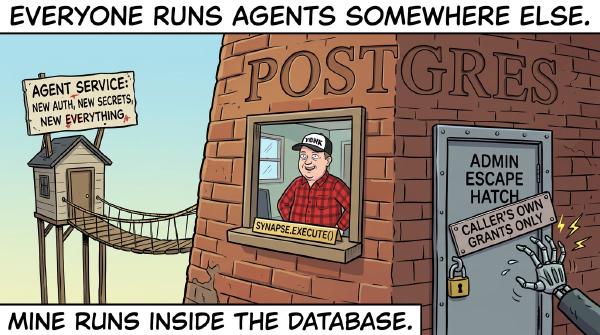
pg-synapse is a Postgres-native agent loop runtime in Rust. Invoke LLM agents from SQL, with tools that read and write your database under the caller’s grants.
pg-synapse ↗ ↖
Postgres-native agent-loop runtime in Rust. Invoke an LLM agent and its tool dispatch from SQL like a stored procedure — the agent reads and writes your tables directly, with a small trait-based kernel and everything else as a plugin.
hector ↗ ↖
TDD/spec planner that turns product intent into small, deterministic Bob campaigns — one observable behavior per slice, with the verify command and scope caps frozen up front.
bob ↗ ↖
·3 mins
Autonomous build → verify → judge loop. Bob drives a coding CLI in an isolated git worktree, gates the result on your own test command, and only applies the change once it converges.
ai-skills ↗ ↖
A library of opinionated Claude Code skills, rules, agents, and slash commands that turn an AI coding session into an actual workflow — scope before planning, research before content, tests before claims, evidence before opinions.

Wire Real Memory Into Your Agent In An Afternoon
The practical follow-up to the goldfish-memory post. Bring a Postgres database with pgvector and an agent that talks to users; an hour later you’ve got two-tier memory bolted on. Staging, realtime and consolidate cells, three scheduling options, three reader patterns, and an LLM fact extractor — Python and Rust both.

Your Agent Has Goldfish Memory (And Your Vector Store Won't Fix It)
Agent memory has two completely different jobs — fast context for the next reply, and curated truth three weeks later — and most people try to do both with one tool. Here’s the two-tier pattern I built chunkshop’s memory layer around, the late-event bug that silently eats conversations, and why ‘just use pgvector’ isn’t the whole answer.