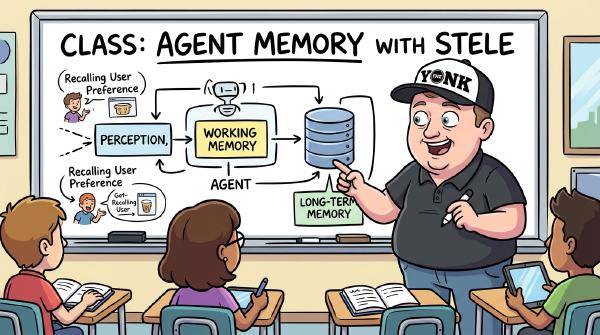
Long-running agents are usually given a memory system that stores facts and retrieves them by similarity, borrowed straight from RAG. We argue that’s the wrong default: cheaply re-derivable facts are net-negative to cache, while the expensive, non-re-derivable thing an agent accumulates, process, is exactly what the field under-builds. We present the Agentic Context and Protocol Ledger, validate it with two policy simulations and a four-model adversarial review, and report four empirical results on staleness, dependency-checked reuse, and the mechanisms that make imperfect dependency declaration safe.
We added semantic search to agent memory, then benchmarked it against plain document RAG on the same questions. The boring baseline won by 6x. Here is why that is the point.
“Add memory to the agent” sounds like one feature. It is six different jobs that need three different mechanisms. Here is the map, with a concrete example for each.
A 150-row benchmark grid looks like the output of a robot having a stroke — until you know the three things each row tells you. A field guide to reading our RAG bake-off: read the parametric floor first, decode the system and lane columns, and ask the only two questions that matter — is it right, and what did it cost?
One failing LoCoMo question turned into a cross-corpus, multi-system benchmark — and a pile of retracted conclusions. Small-N runs lie, cross-vendor numbers are rarely apples-to-apples, and a correctness bug will impersonate an architecture win every time. Run the no-context baseline, 6x your sample, and diff the bytes that reach the model before you trust any RAG number.
The practical follow-up to the goldfish-memory post. Bring a Postgres database with pgvector and an agent that talks to users; an hour later you’ve got two-tier memory bolted on. Staging, realtime and consolidate cells, three scheduling options, three reader patterns, and an LLM fact extractor — Python and Rust both.
Agent memory has two completely different jobs — fast context for the next reply, and curated truth three weeks later — and most people try to do both with one tool. Here’s the two-tier pattern I built chunkshop’s memory layer around, the late-event bug that silently eats conversations, and why ‘just use pgvector’ isn’t the whole answer.
The hands-on follow-up to the why-I-built-it post. Real commands, real outputs: install Stele, wire it into your agent, store artifacts with citations, supersede facts, time-travel with as_of, stash oversized tool output, and run recall through two strategies. Five minutes to install, the rest is just typing.
I said the implementation needed another quarter. Three weeks later I’d shipped Stele — source-backed, time-traveling, sovereign agent memory that plugs into seven coding assistants. What it does, the three goals driving it, what’s solid on main, and what’s still wobbly. The honest version, including the parts that aren’t built yet.
Agentic memory implemented natively in PostgreSQL — the episodic, relational, time-anchored memory layer agents actually forget, kept in the database you already run.