Long-running agents are usually given a memory system that stores facts and retrieves them by similarity, borrowed straight from RAG. We argue that’s the wrong default: cheaply re-derivable facts are net-negative to cache, while the expensive, non-re-derivable thing an agent accumulates, process, is exactly what the field under-builds. We present the Agentic Context and Protocol Ledger, validate it with two policy simulations and a four-model adversarial review, and report four empirical results on staleness, dependency-checked reuse, and the mechanisms that make imperfect dependency declaration safe.
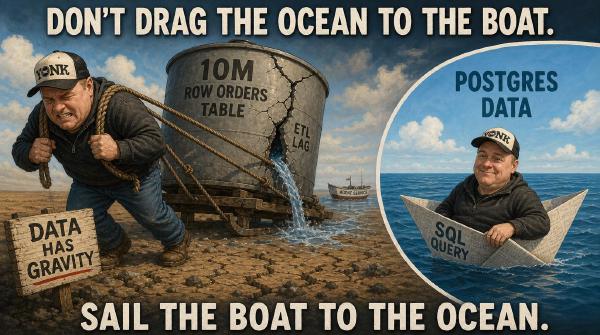
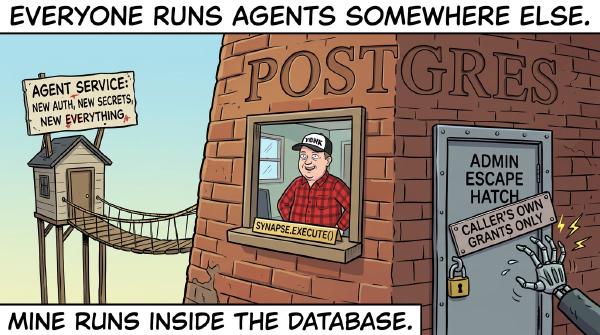
A defense of in-database AI agents: data gravity, security, transactional isolation, backups, replication, and why pg-synapse lives inside Postgres on purpose.
A working tutorial: install pg-synapse, write a tool, register an LLM profile, create an agent as a row, run it from SQL, attach a reactive trigger. All copy-pasteable.
pg-synapse is a Postgres-native agent loop runtime in Rust. Invoke LLM agents from SQL, with tools that read and write your database under the caller’s grants.
We added semantic search to agent memory, then benchmarked it against plain document RAG on the same questions. The boring baseline won by 6x. Here is why that is the point.
“Add memory to the agent” sounds like one feature. It is six different jobs that need three different mechanisms. Here is the map, with a concrete example for each.
A 150-row benchmark grid looks like the output of a robot having a stroke — until you know the three things each row tells you. A field guide to reading our RAG bake-off: read the parametric floor first, decode the system and lane columns, and ask the only two questions that matter — is it right, and what did it cost?
One failing LoCoMo question turned into a cross-corpus, multi-system benchmark — and a pile of retracted conclusions. Small-N runs lie, cross-vendor numbers are rarely apples-to-apples, and a correctness bug will impersonate an architecture win every time. Run the no-context baseline, 6x your sample, and diff the bytes that reach the model before you trust any RAG number.
Strip the filler words out of your documents before you embed them and embedding gets ~25% cheaper for one to two points of retrieval accuracy — flat, across every model I tried. The real lesson isn’t the caveman trick: it’s that twelve test questions will lie to you with a perfectly straight face, and a clean model-by-model story can be complete garbage until you run a few hundred.
The practical follow-up to the goldfish-memory post. Bring a Postgres database with pgvector and an agent that talks to users; an hour later you’ve got two-tier memory bolted on. Staging, realtime and consolidate cells, three scheduling options, three reader patterns, and an LLM fact extractor — Python and Rust both.