Long-running agents are usually given a memory system that stores facts and retrieves them by similarity, borrowed straight from RAG. We argue that’s the wrong default: cheaply re-derivable facts are net-negative to cache, while the expensive, non-re-derivable thing an agent accumulates, process, is exactly what the field under-builds. We present the Agentic Context and Protocol Ledger, validate it with two policy simulations and a four-model adversarial review, and report four empirical results on staleness, dependency-checked reuse, and the mechanisms that make imperfect dependency declaration safe.
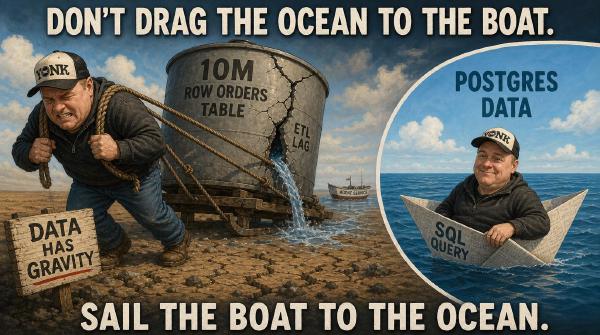
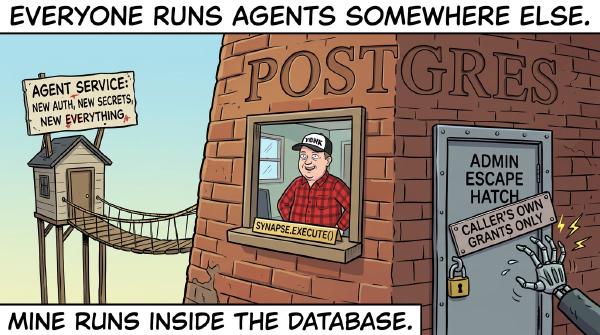
A defense of in-database AI agents: data gravity, security, transactional isolation, backups, replication, and why pg-synapse lives inside Postgres on purpose.
A working tutorial: install pg-synapse, write a tool, register an LLM profile, create an agent as a row, run it from SQL, attach a reactive trigger. All copy-pasteable.
pg-synapse is a Postgres-native agent loop runtime in Rust. Invoke LLM agents from SQL, with tools that read and write your database under the caller’s grants.
We added semantic search to agent memory, then benchmarked it against plain document RAG on the same questions. The boring baseline won by 6x. Here is why that is the point.